A United Left recognizes that we are in a pre-revolutionary context and necessarily rejects schism and in-fighting based on post-revolutionary attitudes and routes to full Communism. A United Left recognizes that the liberation of women, LGBTQ and racial communities, and all other forms of social liberation are all part of the broader social question. We are their allies and support them in their struggles without co-opting them. A United Left is the idea that the Left in the United States can stand united, offering solidarity to those who need it, and a viable alternative to the insurmountable difficulties we face and accept as reality, today.

Sunday, January 12, 2014

Marxism Monday #2: Labor value

Marxism Monday is brought to you today by the letters S&P, for Standard and Poor! Standard and Poor is a financial services company that is a subsidiary of McGraw Hill Financial (who also owns that textbook publishing company...just so you know). They publish market and financial research and their indices track stock health and overall financial and economic health. They're also one of the international credit ratings agencies. So, why is Marxism Monday brought to you by one of the most influential Capitalist organizations in the world? Because of this:


Do you notice anything about those dips? They correspond with the two most recent major sector collapses in the world economy. The first was the general economic downturn after the dot-com bubble collapsed and 9/11 shut down trade and consumer confidence (says Liberals and Capitalists), and the second is the occurrence of the housing bubble collapse and the banking sector collapse in rapid succession of one another. But what precedes both of them are unparalleled periods of growth. Seriously. Go to Google right now and type in "INDEXSP:INX" and it will give you the same page. Expand out the window. This rate of growth is ludicrous. Do you see how close that line is to the bottom before 1995? And look at the far right where it is now at the dawn of 2014.

A much more detailed analysis of economic activity would be necessary to explain fully these massive gains in the S&P 500 (S&P's American index) during periods when real wages are falling drastically against inflation and jobless numbers are down simply because people have stopped looking for work or jobless benefits have been cut. But what these graphs parallel is the state of the worker in relation to industry in Capital, Marx's seminal work. In "Outline and Criticism of Communist Theory from Marx to Mao", James J. O'Donnell explains it simply:

[T]he laborer is himself treated by the bourgeoisie as a commodity, and thus receives only the equivalent of the amount of labor that has been expended in producing him, that is, his subsistence...A laborer earning a daily wage of eight dollars might complete eight dollars' worth of work in three hours. If he works an eight-hour day then the additional five hours represents surplus value. Marx defines surplus value as the difference between the sale price and the worker's wages. It is something actually created by labor but appropriated arbitrarily by employers. (27)

This labor-value appropriation is very apparent when one looks at the above graph in relation to the state of workers in this country and Europe and even in China today. Record profits, record CEO bonuses, record growth in stock markets, etc. Yet real wages are in free fall. Rents and the price of food (specifically milk and eggs, the real measure of the health of the economy) are rising. West Virginia's coal mines are literally destroying clean drinking water while their CEO and his girlfriend laugh. The situation in the United States, specifically, is one in which Capitalists have already begun reaping their rewards for undermining business and banking regulations put in place due to the Great Depression. The worker is finding himself commoditized in ways unheard of since the 1920's. Though not as bad, things are certainly setting themselves up to be possibly much worse. Not only that, but the state and Federal Reserve Bank have run out of ideas on how to fix the problem.

Quantitative Easing didn't work. Letting the market collapse didn't work. Intervention didn't work. Non-intervention didn't work. These are the two strategies our government seems to think are the only viable options. Marxism says there is another option.

Marx posits that when workers control and collectively own the means of production, there is no Capitalist to arbitrarily appropriate the added labor-value contributed by the worker. Therefore, a greater portion of the final price of the commodity can be appropriated to the worker's wages. With rules in place (or psychological barriers, but that is a topic for Marketing Mondays...on another blog) to keep commodity prices from artificially inflating, consumer confidence returns. And Socialist or Capitalist, consumer confidence is important because it means 1) items are available to buy, and 2) they are being bought. Say what you will about consumerism (it's bad), any economy that still utilizes a currency relies on consumer confidence. Unless we're talking about Owenites, and I don't think we are, this holds true for most transitional Socialist societies as well. Ask Slavenka Drakulic, in her book "How We Survived Communism and Even Laughed". She says the reason Communism failed was because they did not produce enough tampons--her metaphor for consumer goods. And really, this is a common complaint from the former Soviet Bloc: everyone had plenty of money, but they were still standing in line for bread.

But, I'm in danger of veering off into tangential history. The point of this Marxism Monday can be summed up very briefly:

The price of any item is composed of three things: 1) the cost of initial goods to make the item, 2) the added labor value imparted by the worker, 3) profit. Labor value is calculated (according to Marx) as the difference between the sale cost of an item and the initial cost to make the item. The allocation of profit in Capitalism is arbitrarily done according to the individual desires of the Capitalist. The allocation of profit in Communism is intentionally done according to the collective needs of the workers. Arbitrary appropriation of labor value results in volatile markets, uncontrollable collapses, and vast increases in financial indices simultaneously alongside freefalling real wages, dangerously-high inflation, and uncontrollable cost-of-living increases. Intentional appropriation of labor value helps fix the market, ensure high standards of living, and overall economic health.

Now, this does raise a valid question, and one that has been alternately taken seriously and generously dismissed by Marxists and Capitalists, alike: that of the Socialist "value calculation"--that without a free and competitive market, how would economic value and item price be determined? Understanding the abstracted idea of what composes a "price" according to Marx, we will look into this next week on Marxism Monday.

Saturday, January 11, 2014

Anarchist Memes is now pro-Capital! Wait what?

As reported at CounterPunch, one of the most stalwart anti-Capitalist pages on Facebook, Anarchist Memes (I've linked you to the current iteration), was taken down Thursday January 9, 2014. I won't get into the story of that, as CounterPunch does so fantastically. But what is of particular interest is that the same day another page was started with the same name, the same (mostly) logo, and the same approach to political graphics and propaganda. Yup. There's another Anarchist Memes page, but they have nothing to do with Anarchism at all. They're AnCaps. And if you click on the links you'll see that the same logo is being used, only the latter has changed the flags to yellow. Bright, happy, yellow flags denoting their devotion to Capitalism.

I saw that and felt like I had just gotten punched in the dick about thirty times. In terms of sensibility and common decency, the creation of this new group is a direct attack against the very active and formidably-mobile Left. Over the past several years, the very real and very dangerous ideologies of the extreme right have been targets of coordinated attacks by groups on the social network. Leftist groups have dismantled arguments by voluntaryists, free-market ideologues, and everybody else who falls under the AnCap umbrella (though, like hipsters, we're all aware of how vehemently they all deny being AnCaps). While they have ventured into our territory a number of times, their arguments are quickly shredded and they leave claiming the "I never cared to begin with" card or just up and quit. This, however, is a direct appropriation of ideas, images, and intellectual property from their ideological opponents.

Now, I'm not saying we should fall to pieces over an internet pissing contest. Honestly, what good is happening in the world by us fixating on these Facebook-based ideological wars? In terms of real human terms, such as lifting people out of poverty, asserting the rights of labor over the rights of capital, etc., these Facebook wars do nothing. But, knowing Facebook's attitude towards the far left, this type of appropriation stings deeply. We know that in any battle between the two AM pages, Facebook will ultimately ax the original, the radically left AM instead of the radically right AM. We know this to be true, and so the existence of the usurper represents an existential threat to one of the most vibrant and well-managed anarchist communities on Facebook.

This is a threat that must be answered according to the strictest code of solidarity. Yes, we've seen the way Anarchists attack Marxists, Leninists, Maoists, Trotskyites, etc. We know that Anarchists are just as sectarian as we are. But to stand silently while this battle rages only means it will be that much harder the next time this happens. And the next, and the next. Always remember Niemoeller's poem, "First they came..."

First they came for the Socialists, and I did not speak out--Because I was not a Socialist.
Then they came for the Trade Unionists, and I did not speak out--Because I was not a Trade Unionist.
Then they came for the Jews, and I did not speak out--Because I was not a Jew.

Then they came for me--and there was no one left to speak for me.
This is the environment in which we are finding ourselves. Because of this, we must be willing to defend each other in the face of a reactionary right that fancies itself "humane", but laughs as the left is torn to shreds in the name of "Community Standards". They can have their misogyny, their racism, their classism, their homophobia, and their Islamophobia. This is something we know that Facebook will not remove. But our existence and are goals are made easier, more evangelistic, more attainable by being allowed to speak on a social network that has defined the dominant social paradigm of our age. When they take this away from us because we cannot unite in the name of solidarity, the fight will be the same fight we were undertaking in the 1980's and '90s, and the Left's crisis of relevance will be magnified a thousand fold.

This is why the usurped AnCap page is so important. This is why our petty arguments on Facebook are important. This is why solidarity is important.

Friday, January 10, 2014

Fresh Friday #2

Happy Friday! It also happens to be my sister's birthday today, so I'm getting jazzed up to celebrate with her on Sunday (we all work too much). That being said, let us engage in some new ideas.

I had originally had a lot of trouble thinking up what I was going to discuss today. I had tried culling some articles from my collection, trying to rehash some theories and ask some questions, but then something happened that sparked my curiosity, and at the same time allows me to refer back to Fresh Friday #1, on Evangelical Marxism. So, on to Fresh Friday #2:

On the Integration of Social Media in Party Organization
-E.M. Diderot

It is the prerogative of any Marxist organization to administer its business according to their own rubrics. If this is according to Lenin's Democratic Centralism, or total political democratization, it is the prerogative of the organization to choose its means of administration. Just as any revolution will look different based on the socio-political context of the revolution, so will any organization's administration look different based on the same contextual concerns. This, however, has its limits when it comes to strategy and evangelization of the organization.

At its core, the mission of the organization should be twofold: the ultimate usurpation of the state and fundamental restructuring of society to rid the state and the workers of the parasitic bourgeoisie, and the protracted working goal of evangelization. The state cannot be usurped with a minority or else this would constitute a coup and in no way represent a revolutionary social shift as is necessary for the building of Socialism. It must be attained through protracted class struggle by a violently conscious working class. The only way to attain that level of class consciousness is through the twofold approach of education and integration. All other short-term working goals are subordinated to this one--of expanding the organization and invigorating it with new blood.

As part of an evangelical approach to Marxism, it is imperative that any tool that allows a Marxist organization to reach as many people as possible be utilized. Social media has given us unprecedented ability to do this, even as Facebook attempts to shut down anti-Capitalist, Feminist, LGBTQ, non-heteronormative, etc. pages while defending heteronormative, anti-Feminist, pro-Capitalist pages. Facebook is a tool that must be recognized for what it is: a way to coordinate and attract like-minded comrades from every corner of the globe. It is also a way to establish coordination networks for local actions off of Facebook, since the network records what you DON'T share, and has the potential to start recording what you do. Despite this, the administration coteries of several Communist, Anarcho-Syndicalist/Communist, Socialist, etc. groups make it a point that only people who are known outside of the network in real life (IRL was an acronym I hadn't seen for awhile...ahh nostalgia!) are to be considered for administration positions.

While laudable since it is a way to verify the intentions, history, and credibility of a potential admin, it is severely limiting and self-defeating. If one's purpose is to build a loyal organizational base administered only by people you know in person, it is far easier and more sensible to do it the old fashioned way out of a basement somewhere and shun the social networking. It means that no matter how the evangelization of Marxism effects the membership of your organization, if there is no prospect for their advancement because you do not know them personally outside the online face of the organization, they might as well not exist, and your membership numbers should be revised to reflect that only the administrative core exists as members.

Instead, any evangelical approach to Marxism must recognize that we all exist outside of the internet. And while this does not mean everyone who joins up on your Facebook page must be guaranteed administrative access, it means the requirements and rubrics by which administrative promotion is done must be revised. Contributions to the organization via news items, reports about activities of enemy organizations (AnCaps, anti-Feminists, etc.), conversational contributions, and extra-organizational contributions via publications and direct actions should be weighed against the requirements to be given administrative access.

Why is this so important? Because, believe it or not, genuine Left organizations do not exist in all areas. Just as any revolution will take on different forms in different climes, and any organization will take on different forms in different settings, Leftists take on different forms in different conditions. The Communist Party USA and Socialist Party USA are all Social Democrats and do not represent the political Left in any meaningful sense. American trade unions are mere tools for the further exploitation of their membership by Capitalists, and grassroots Leftist organizations are very easily co-opted by well-intentioned but poorly-educated Liberals. So, in many places, devoted comrades do not have access to other comrades and organizations. If we are to overcome Communism's crisis of relevance in a post-industrial, service-oriented economic environment, we must use the tools available to us in every instance to spread Marxism, raise class consciousness, and secure the revolution. We cannot rely on the operational strategies of the 1880's, 1910's, 1950's, or even the 1980's. In the Twenty-First Century, at the dawn of 2014, our methods and strategies must reflect the technological changes that have occurred in the almost 140 years of Marxist history. If we fail to do so we will die, and the world will die with us.

Thursday, January 9, 2014

Theory Thursday #1


Originally my Theory Thursday #1 post included a very lengthy (and at times, wandering) analysis of Hal Draper's and Anne Lipow's introduction for a collection of texts they title "Marxist Women vs. Bourgeois Feminism" (1976). In the course of writing this post, I also had the chance to run several items in it by comrades within and without Marxist circles at the same time. A lot of arguments were put forth that I had to think about and a lot of concerns that developed because of it. So I am changing tactics. I would still like to draw on Draper/Lipow, especially considering their discussion includes works of such seminal Marxist Feminists as Clara Zetkin, Rosa Luxemburg, and Eleanor Marx (the full introduction and list is here), but it is more important now to simply address the question of Marxist Feminism in general. Why have I reasoned this?

My original post blatantly and routinely attacked core problems in Liberal Feminism perceived as parallels addressed in attacks by Zetkin, et. al. in the 1880's in Germany. Why is this a problem? What would you think would be the response of any woman who is conscious of her feminism to a man telling her why Liberal Feminism is wrong? It would appear to be the same idea as any man or men trying to co-opt feminism for their own ends and telling women why they should let men co-opt it. So, even without publishing that first draft, I would like to extend an apology to all women, feminist or not, that my original intention was blind to what would be termed my male privilege. I am sorry that my intention would have offended you. Let me instead try and present arguments by Marxist Feminists that will be there for your consideration, and maybe we can talk about it over coffee some time. I like coffee.

ONWARD!

I would like to begin with a clip illustrating some quotes from Clara Zetkin, who founded a socialist women's group in Germany in 1872:


The core of Zetkin's feminism is the same as Marxist Feminism in general. The plight of women and their subsequent lack of equality is inherently the byproduct of the relations of production. When men solely provided for their families, women were subordinate. When industrialization required men and women to work side-by-side, Zetkin argued that women's economic emancipation was complete, and much of this was done without the aide of men and often in opposition to men. But once women's economic emancipation was complete, it was imperative for men and women to work together. For Draper/Lipow, it is summed up rather coherently:

"In the Marxist perspective, the entrance of women into industry was not itself the solution; it merely posed the right questions for solution. It provided the necessary starting-point for struggle. The struggle had to include a fight against the abuses of female labour along with other workingclass struggles. Once one saw the female half of the human race as an integral part of the great social struggle, everything else followed. [The] Marxists' approach pointed...to the integration of women into every aspect of the social struggle, including the political."

This is the most succinct discussion of Marxist Feminism that I have come across. Women and men do not stand in opposition (or should not, at any rate), and should be fully integrated in every aspect of the social struggle. Going back to Zetkin, this denies a focus on women's roles and rights in a purely juridical sense and explains Zetkin's, Marx's, and Luxemburg's open hostility towards "Bourgeois Feminism" (what we would call Liberal Feminism, today), which sought and continues to seek an active legislative solution--something Marxist Feminism denies as being effective.

The alternative to focusing on the status of women in a purely juridical sense is focusing on the status of women in a revolutionary sense. It is not enough to take the present system, says the Marxist Feminist, and enact laws and reforms that protect women from the internal machinations of Capitalist society that seek to undermine the emancipation of women. It is necessary to force the capitulation of Capitalism so that Socialism can replace it to guarantee the emancipation of women in a classless society, since their subordination stems directly from economic exploitation and class antagonism. The logic here is that juridical reforms can be taken away, whereas a truly revolutionary social shift cannot be so easily undone.

As an illustration of this thinking at work, one can praise the hundred plus years of feminist gains in the United States. But if a juridical approach was sufficient to changing culture, the Republican War on Women should be spearheaded by men who came of age during, before, or shortly after Roe v. Wade, or those men who spearheaded the offensive that helped derail and ultimately defeat the Equal Rights Amendment. But it isn't. The War on Women is being led by the youngest members in the Republican caucus. It is being headed by the likes of Rand Paul and Paul Ryan. Yes, men like Todd Akin and Rush Limbaugh have come out as openly misogynistic, but all they do is add "tradition" and "moral support" to the young blood leading the charge. The past couple of years, reproductive rights restrictions in the United States have outstripped the restrictions passed in the past several decades combined. In this instance, at the very least, Marxist Feminism says the juridical focus is misapplied and is not working.

So what is the solution? Over the next few weeks I will be discussing the list of works in Draper/Lipow's "Marxist Women vs. Bourgeois Feminism". While much of this work lies in the canon of Marxist Feminist theory as having built the foundation of the theory 130 years ago, I posit that its age is not an issue since the problems they address are still problems today. To understand Feminism, one needs to understand its origins. Likewise, to understand Marxist Feminism, one needs to understand its origins among early revolutionary Marxists.

Saturday, January 4, 2014

Iraq: Post-Colonialism and Neo-Colonialism

I saw a wonderful article on Global Post today that just says Iraq is a mess. Seriously. That's what their Facebook status update said about the article. "Iraq is a mess." Nothing else, nothing more. The liberal press is even losing any and all interest in a part of the world that the West has intentionally and routinely fucked up. What is the article about? Fallujah is in the hands of Islamists, and Iraqi security forces are preparing to retake it. Woo. Fucking. Hoo. That's the same story that's been coming out of Iraq since the war started. But, the narrative between liberals and conservatives is the same. One side will say "Iraq needs more security!" the other will say "Iraq needs self-government!" and sometimes they agree and sometimes they flip back and forth, but generally both sides fundamentally miss the point. What Iraq needs is to never have existed at all.

The modern state of Iraq is an amalgamation of territories formerly held by the Ottoman Empire. Various kingdoms have occupied the area and ruled from Baghdad or Mosul, but the region has always been pretty stable. Under the Ottoman Bey system local rulers were allowed to govern how they wanted so long as they paid tribute and maintained allegiance to the Ottoman Sultan. Then WWI happens, the Ottoman Empire is dissolved, the Young Turks create a Turkish Republic, and Britain gets control of "Iraq". As was a popular past time of European powers of the period, the British elevated one group of people to rule over everyone else, exacerbated inter-tribal differences, stoked the flames of religious sectarianism, and then pointed to the problems THEY created as the reason why European "enlightenment" was necessary in the region.

A hundred years on and the problems have resurfaced. Why? Because in the 1950's a part of the general post-colonial Pan-Arab movement saw the creation of the Ba'ath Party. It was nominally Pan-Arabist, but had a great deal of Socialist ideology behind it. Ba'athists came to power in Jordan, Syria, and Iraq, and the Egyptian government was sympathetic to them. What Ba'athism represented was not simply an Arabic Socialism. It was a unifying narrative that bridged the gaps between the differing ethnic and religious groups in the area. Why was it so important to Saddam Hussein to keep Islamic extremists out of the country? They represented a "solution" to the post-colonial question that would only serve to worsen the problems they were trying to solve. In this way, Western Liberalism looks a lot like Islamic Extremism. While the motivations may be different, both offer solutions that only exacerbate existing problems.

With the absolute gutting of Ba'athism (not helped by excesses and abuses of power by Ba'athist leaders), Iraq lacks a unifying narrative. They have been returned to the same position they found themselves when the British mandate was finished and Iraq gained independence following WWI. An entire century has been wasted because of Western imperial interests in the region. The Liberal solution to Iraq has always been "work with and promote groups that are sympathetic to Western Liberal Democracy". This is the same way the British administered the region. And it is having the same effect.

Western Liberalism is doing in Iraq what it is doing in post-colonial Africa--providing nothing but the same--and it is destroying the places and lives of the people the West is parasitically dependent upon. Thank you Global Post for reminding us that even liberal media outlets are ignoring these people since it doesn't bolster your beloved President-Messiah Obama.

Friday, January 3, 2014

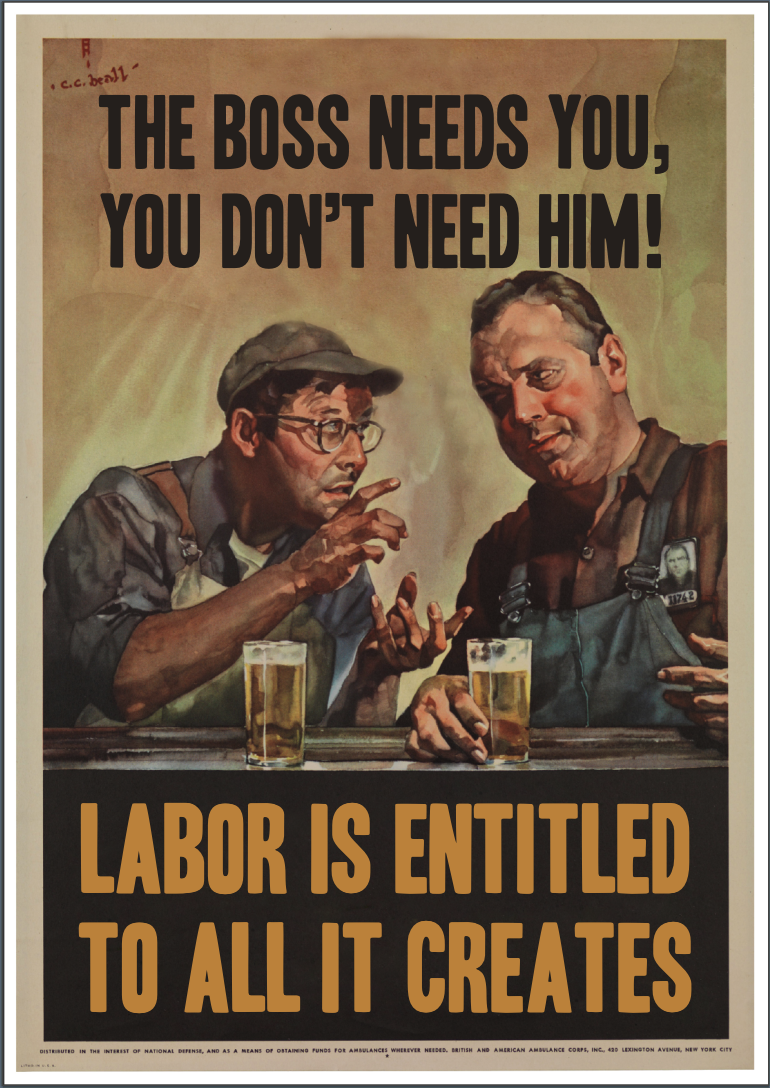
The Boss


All I could find is that this is an American labor poster from 1938, despite a google search (I LOVE the "Search Google for this image" function) telling me the "closest" it could find is Nazi propaganda. Does Google have an agenda? Probably. Their "Do No Evil" slogan from their early days seems to have disappeared as soon as the NSA got involved...but that's a tangent for another time. Anyhoodle, I miss old propaganda posters like this and would like to showcase them from time to time.

Fresh Friday #1

So anyone who read the Inaugural Address post will know that I missed one of the features I promised (Theory Thursday). That was quite unintentional. You see, I'm recently recovered from a broken foot and will be returning to a full time schedule this upcoming week and I was trying to cram as much social time in as possible during my last long mid-week-off. For those interested, I wanted to discuss Hal Draper and his feminism. Since I did not do this, it gives me another week to go over it again and hit any points I might have missed and it will give you guys a chance to familiarize yourselves with the text as well. But, Fridays are not for theorists who are well and published and properly established. Fridays are for fresh ideas, or ideas that I at least think are new. So, without further ado, onto my first installment of Fresh Fridays.

An Evangelical Marxism: How to Approach Marxist Social Education in the Twenty-First Century
-E.M. Diderot

Under the (now) Blessed Pope John Paul II, the Catholic Church embarked on something called the "New Evangelization", the idea that the way the Church interacts with the world is out of sync with how the world has developed in the last century. Pope Emeritus Benedict XVI also talked about the New Evangelization, and entered into a broader ecumenical dialogue with other Christian denominations and interfaith groups. So far I haven't seen Pope Francis say anything about the New Evangelization, but his platform centered on Social Justice and (tentative) Liberation Theology seems to be on par for the course. What does this have to do with Marxism?

First, the point of this blog is discussion on the creation of a United Left. There is no point to creating a united left unless this unification can attract new blood. In the Twenty-First Century, Marxism is suffering a crisis of relevance in the same way as the Catholic Church. Both Marxists and Catholics see themselves as fundamentally relevant to the creation of solutions for the world's endemic problems, but both are finding a hard place to gain a foothold to inspire mass cultural and social change. A lot of this is rooted in the fact that the Catholic Church still approaches its interaction with society in general and its congregants specifically from the standpoint that it did in the Nineteenth Century. Marxism is very much the same. The development of high degrees of economic specialization, technological advancement, and the birth of the internet and social networking have fundamentally changed the relationship of labor to capital in the modern economy. But much of our language and educational strategy is still firmly rooted in the romanticized notion of the flatcap Irish immigrant in a steel mill twelve hours a day. Capital is still firmly represented with top hats, and that is something WE need to appropriate. Ngyes! (Nigel Thornberry accent required)

Secondly, the language and posturings of religious institutions for (largely) religious populations has been a very effective and prolific strategy in Marxist enterprises around the world. For an in-depth look at how the Bolshevik Party appropriated religious language, attitude, and mentality for its own message in Russia, please reference Nikolai Berdayev's The Religious Foundations of Bolshevism. So, in the United States, the land of Sara Palin, Michele Bachmann, and others, a country where the fastest growing demographic are underpaid, overworked Central American Latino Catholics, why would it not be beneficial to adopt the same language and strategies as a revitalized Catholic Evanglization? Approaching Marxism in an evangelical fashion would not be limited to Catholics, either. The United States is the birthplace of Evangelical Christianity, with its roots in Southern Baptism. Adopting the same sort of apocalyptic language and charismatic posturing would do wonders to draw parallels between the theological hell being prophesied by their fire-and-brimstone preachers and the very real material hell in which they live, now.

If it is the considered opinion of a United Left that the Evangelical Strategy be promoted, it would become necessary for all Marxists to familiarize themselves with the writings of Liberation Theologians and Evangelical and Charismatic Christian authors. Principally, this is due to two factors:
1. It would allow the easy generation of arguments that clearly explain Marxist positions in language that is immediately recognizable and accessible to the masses; and
2. It would eliminate the highly academic air that much Marxist discourse has in the Twenty-First Century today.

This second point I feel is the most important thing we need to combat in approaching cross-ideological Marxist education, today. Much of our language has become increasingly technical and highly sect-specific. To an outsider, this vocabulary is not easy to understand, and it is not their responsibility to educate themselves before encountering it. How many coffee-house conversations have ended due to mutual frustration when the other person "just doesn't get it"? How many times have you had to sidetrack your main argument just to explain a term or concept that is self-evident to you? By adopting the language of the most virulently anti-Marxist populations in the country, we can make these terms and concepts self-evident, as well, and we can get the point across much, much sooner.

Problems and contradictions:

Marxists are materialists, first and foremost. Religion is not a materialist philosophy, and it must be combated. However, I hold that religion in and of itself as a concept is not harmful. Therefore, the focus should not be an offensive war against religion as a social institution, but, instead, an offensive war against the problems that force a need for religion. The religious can very easily be our allies. It was the revolutionary anti-religious attitude of the First International that received the condemnation of Marxism by the Holy See in the first place. It is why the evolution of Liberation Theology has been so troublesome. It is why concepts like "Christian Socialism" and "Christian Communism" have built-in contradictions. The generational impact of a social norm that says "Communism is Anti-Religion" implies that nothing good can come out of Marxism, therefore, its arguments, no matter their validity, must be vigorously combated even when it is against one's own self-interest to do so. Is it any wonder that the Republican Party has so effectively undermined the self-interests of the poorest and most vulnerable in our society, yet continue to garner their support?

Marxists must understand that their anti-religious position must as a matter of pure necessity and pragmatism carry with it the caveat that religion will exist so long as it is necessary. Legislating it out of existence (even in a post-revolutionary hypothetical America) will not be possible. It cannot be done in the United States. The First Amendment is more inviolable than the rest of the Constitution in its entirety. What must be sought, instead, is alliance with the religious community, especially the Catholics who already make up a plurality of self-identified religious Americans, so that the reasons religion is sought out can be addressed and corrected. When all religions fade away, the First Amendment will still be there, just in case a new religion springs up.

Second issue: how to overcome anti-Communist bias and stigma among the religious right. It can be done, but it must be done in the same way one church poaches the membership of another. Marxists MUST represent themselves in a moral and an ethically positive way. This should be a matter of fact and self-evident to all Marxists whether they embrace a Marxist Evangelization or not. We seek a humanitarian end, yet we do not always behave as humanitarians. The revolutionary period of American history has not yet come, so we do not need to concern ourselves with violently ridding ourselves of the Capitalist system. To engage the world in the way that St. Paul demanded of the early Church, but with a Marxist ethic rather than a Christian one, would do more to inspire people to overcome their anti-Communist bias than anything else. And if we are already armed with the language and vocabulary of the religious right, it is simply a matter of having coffee with them, and an entirely new demographic will be added to the cause and movement of the United Left.